


Critical Minerals, Interventionism, and the Hidden Costs of U.S. Supply Chain Policy

In a recent post, I described U.S. import dependence on critical minerals essential to renewable energy and other advanced technologies, along with policy options to reduce supply chain vulnerabilities. One option—expanding domestic mining and processing—is quickly gaining traction across government, industry, and academia. Free-market investment and development do offer a long-term, potentially economically sustainable path. But policymakers have also begun deploying government-backed financial support to speed up this effort, and more intervention is likely. Because interventionism is being presented as essential to the domestic solution, it is worth examining its potential downsides.
Many analyses acknowledge critical minerals supply chain vulnerability, but few ask how the U.S. arrived here. In medicine, treating symptoms without addressing root causes rarely leads to lasting recovery. If we agree there is a problem, the first question should be: what caused it?
Widely talked about causes of the supply chain gap include foreign supply concentration, geopolitical instability, underinvestment in domestic production, and rising demand from renewable technologies. But with a few exceptions, these risks trace back to a deeper root cause: U.S.-imposed policies and conditions that made the country dependent on a global supply of critical minerals in the first place.
The reality is that decades of accumulating regulations, shifting policies, and intermittent government interventions in the United States have made domestic mining and processing slow, expensive, and uncertain. Companies face prolonged permitting timelines, overlapping federal and state requirements, and the risk of policy changes mid-project. It is not uncommon for an American mine to spend a decade in review, only to face additional delays from litigation or regulatory shifts. While these factors are not unique to the U.S., and some rules may serve legitimate environmental and community goals, the overall consequence is unpredictability and rising costs that deter domestic investment.
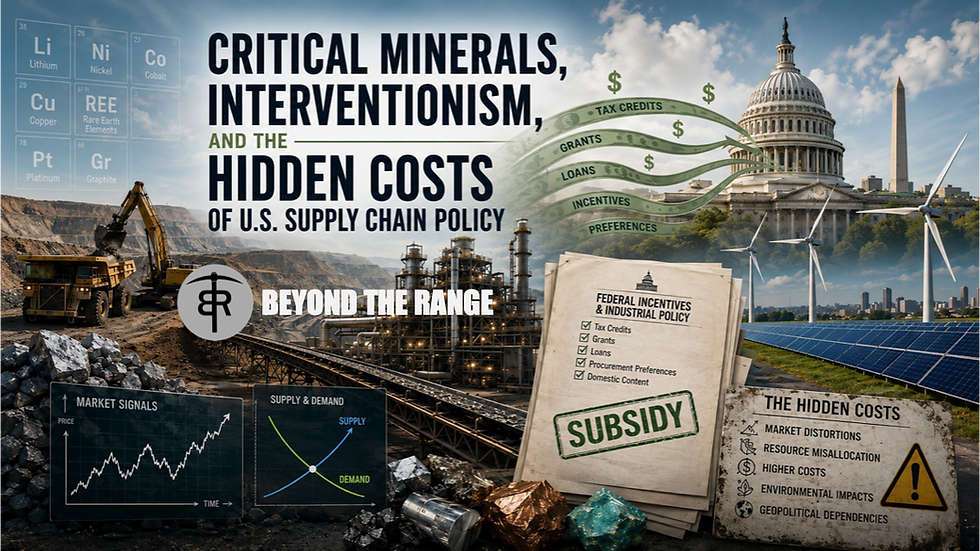
Now, in response to the resulting supply gap, the U.S. government is stepping in with subsidies, loans, equity stakes, and price guarantees. Programs tied to legislation such as the Inflation Reduction Act and CHIPS and Science Act, along with Department of Energy financing tools, aim to de-risk projects and accelerate development. In some cases, the federal government is underwriting investments, orchestrating offtake agreements, or guaranteeing minimum prices. These measures may stimulate activity in the short term, but they also mark a significant expansion of direct government involvement in markets historically driven by private decision-making. A further risk is that large intervention programs invite favoritism, lobbying, and rent-seeking, allowing politically connected entities to capture benefits that may have little to do with long-term national resilience.
This creates a cycle: policy-driven constraints contribute to supply limitations, which then justify further intervention. As Ludwig von Mises observed, intervention often compels actions that would not otherwise occur in a free market. Subsidies and mandates distort price signals, encouraging decisions based on political incentives rather than supply, demand, and scarcity. At the same time, regulatory complexity slows the ability of producers to respond to shortages. The result is a more fragile system that invites still more intervention.
The knowledge problem further complicates this approach. As Friedrich Hayek noted, central planners cannot reliably predict future conditions. Governments try to decide which minerals will remain critical, which technologies will dominate, and which projects deserve support—all under uncertainty. Yet no person, profession, committee or task force possesses the all-seeing knowledge necessary to do this. In reality, these decisions are shaped by forecasts, political priorities, and lobbying, none of which guarantee accurate outcomes. Meanwhile, public funds are increasingly committed based on these judgments.
This raises the risk of malinvestment—capital directed by policy rather than market discipline. Projects that appear viable today may become uneconomic if prices shift, technologies evolve, or demand projections fall short. In such cases, taxpayers bear the downside, while private actors may be insulated. Rather than building resilience, interventionism creates dependency on continued government support.
A more prudent approach would focus on simply removing the barriers that contributed to the problem. Policymakers could streamline permitting processes, reduce regulatory overlap, and provide greater policy stability so that long-term investments become more feasible. Allowing prices to reflect real supply and demand would better guide production, innovation, and recycling efforts. Targeted national security measures—such as limited stockpiles—may be appropriate, but broad attempts to engineer commercial supply chains risk misallocating resources.
Markets, when allowed to function, have a strong record of adapting to resource constraints. Higher prices incentivize exploration, efficiency, and substitution, while lower prices signal reduced scarcity. Though imperfect, private actors, investing their own capital, tend to allocate resources more effectively than centralized decision-making.
The importance of critical minerals to U.S. economic and national security is real, and it certainly deserves attention. But solutions that involve central planning should be evaluated carefully. Heavy reliance on government-backed financing and intervention does not address the root causes of the current vulnerability and introduces new fiscal and economic risks. A more sustainable path begins with removing the structural, self-imposed barriers that constrained domestic production in the first place.
©Beyond the Range 2026. All rights reserved. Feel free to republish so long as credit is given.


Comments